
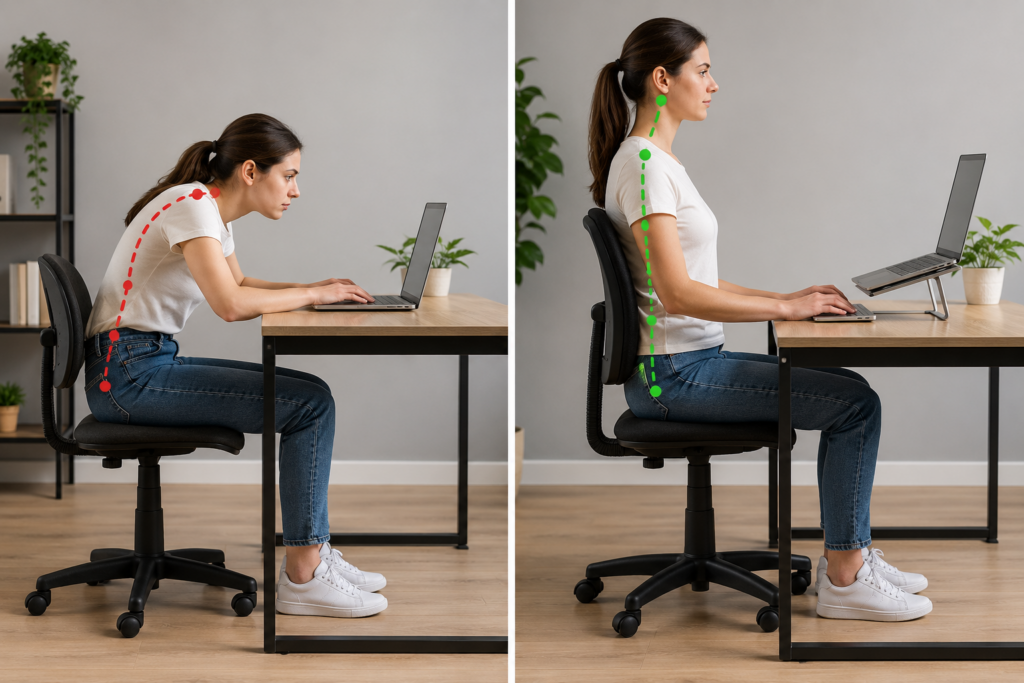

If you’ve ever caught yourself slouching at your desk, craning your neck toward your phone screen, or feeling that familiar ache in your upper back by mid-afternoon, you’re not alone. Proper posture is one of those things most of us know we should work on — but few of us actually understand why it matters so deeply or how to improve it in a lasting way. Here in Washington, DC, Dr. Andrew Hancock and the team at Friendship Heights Chiropractic see patients every day who are dealing with the real-world consequences of poor postural habits. The good news? With the right information and a little consistency, meaningful improvement is absolutely within reach.
What Is Proper Posture?
Proper posture refers to the alignment of your body — specifically your spine, joints, and muscles — in a way that places the least amount of strain on supporting structures during movement and rest. In simple terms, it means your body is balanced, stacked efficiently, and not fighting gravity. Good posture isn’t about standing rigid like a soldier; it’s about finding a natural, sustainable alignment that keeps your body feeling its best.
Why Posture Matters More Than You Think
Most people associate poor posture with back pain — and that connection is absolutely valid. But the impact of posture on your overall health goes far deeper than an achy spine. Your posture influences how your muscles work, how efficiently your lungs expand, how blood flows through your body, and even how your nervous system functions. When your spine is properly aligned, your brain and body communicate more freely through your nervous system. When that alignment is off, the effects can ripple throughout your entire body.
Research published through organizations like the National Institutes of Health has suggested that chronic poor posture can contribute to musculoskeletal pain, reduced lung capacity, increased fatigue, and even changes in mood and confidence. That’s a significant list for something as seemingly simple as how you hold yourself. Here in Washington, DC, where so many residents spend long hours commuting, sitting at desks, or working on laptops in coffee shops, postural stress is an everyday reality.
Your spine has three natural curves — in the neck (cervical), mid-back (thoracic), and lower back (lumbar). Proper posture preserves these curves in a balanced, neutral position. When these curves are exaggerated or flattened due to poor habits, the surrounding muscles, ligaments, and joints are forced to compensate. Over time, that compensation leads to tension, discomfort, and dysfunction.
Common Causes of Poor Posture
Poor posture rarely develops overnight. It’s usually the accumulated result of habits, environment, and lifestyle choices that quietly reshape the way your body holds itself. Understanding the root causes is the first step toward making meaningful change.
One of the most common culprits in today’s world is prolonged sitting. Whether you’re working at a desk, commuting on the Metro, or relaxing on a couch, extended periods of sitting tend to cause the hips to tilt forward, the lower back to flatten, and the shoulders to round forward. Add a screen at eye level — or worse, a phone you’re looking down at — and the neck begins to jut forward in what’s often called “tech neck” or forward head posture.
Muscle imbalances also play a major role. When certain muscles are chronically tight and others are chronically weak, the body adapts by shifting its alignment to accommodate those imbalances. For example, tight hip flexors from sitting can pull the pelvis into an anterior tilt, exaggerating the curve in the lower back. Weak core muscles can fail to support the spine properly, allowing it to sag or compensate in unhealthy ways.
Other contributing factors include carrying heavy bags on one shoulder, sleeping in unsupportive positions, footwear that doesn’t support your gait, and even emotional stress — which tends to make people hold tension in their shoulders and neck. At Friendship Heights Chiropractic, Dr. Andrew Hancock takes a thorough look at all of these contributing factors when evaluating a patient’s posture and overall spinal health.

Signs Your Posture May Be Affecting Your Health
Posture-related problems don’t always announce themselves loudly. Sometimes the signals are subtle — a little stiffness in the morning, mild headaches at the end of the workday, or a vague sense of fatigue that doesn’t quite make sense. Other times, the symptoms are more obvious and harder to ignore.
Common signs that your posture may be contributing to health concerns include persistent neck or upper back pain, tension headaches that originate at the base of the skull, shoulder tightness or limited range of motion, lower back pain that worsens after sitting for long periods, and numbness or tingling in the arms or hands. These symptoms can all be connected to spinal misalignment and muscular imbalance driven by postural habits.
One particularly telling sign is what you look like when you’re relaxed. If your shoulders roll forward, your head sits in front of your shoulders rather than directly above them, or one hip appears higher than the other when you stand naturally, these are visual clues that your posture has drifted from its healthy alignment. Many patients who visit Friendship Heights Chiropractic in Washington, DC are surprised to learn just how much their default resting posture has changed over the years — and equally surprised by how much better they feel once they start addressing it.
How Chiropractic Care Supports Better Posture
Chiropractic care is one of the most well-established, non-invasive approaches to addressing posture-related issues. At its core, chiropractic focuses on the relationship between spinal structure and overall function — which makes it a natural fit for helping patients restore and maintain proper alignment.
Dr. Andrew Hancock at Friendship Heights Chiropractic begins with a thorough evaluation that looks at how your spine is currently aligned, where restrictions or misalignments (called subluxations) may exist, and how those issues might be contributing to your symptoms and postural patterns. From there, a personalized care plan is developed that may include spinal adjustments, soft tissue work, and rehabilitative guidance.
Spinal adjustments are gentle, targeted movements applied to specific joints in the spine that have become restricted or misaligned. Evidence from organizations like the American Chiropractic Association and the National Center for Complementary and Integrative Health indicates that chiropractic adjustments can be effective for reducing musculoskeletal pain, improving mobility, and supporting overall spinal function. These are not one-size-fits-all treatments — each adjustment is tailored to the individual’s anatomy and needs.
Beyond adjustments, chiropractic care at Friendship Heights Chiropractic emphasizes patient education and active participation. Dr. Andrew Hancock works with patients to help them understand the postural habits contributing to their problems and provides practical guidance they can apply in their daily lives. The goal is never dependency on care — it’s empowerment and lasting improvement.
Practical Tips for Maintaining Proper Posture Daily
Good posture is a skill, and like any skill, it improves with awareness and consistent practice. Here are some of the most effective, evidence-supported strategies for protecting your posture throughout the day.
Set up your workspace wisely. Your computer monitor should be at eye level so you’re not looking up or down at your screen. Your chair should support the natural curve of your lower back, with your feet flat on the floor and your knees at roughly a 90-degree angle. If you’re working on a laptop frequently, consider an external monitor or laptop stand to bring the screen to an appropriate height. Here in Washington, DC, where remote and hybrid work remains very common, a well-designed home office setup can make a dramatic difference.
Move regularly throughout the day. No matter how ergonomically perfect your workstation is, staying in any one position for too long is hard on your body. Aim to stand, stretch, or walk briefly every 30 to 45 minutes. Even a short walk down the hallway can help reset your posture and relieve accumulated tension.
Strengthen your core and posterior chain. Your core muscles — including your deep abdominals and back extensors — act as the natural support system for your spine. Exercises that strengthen these areas, such as planks, bird dogs, and glute bridges, can help your body maintain proper alignment more effortlessly. Dr. Andrew Hancock can help guide you toward movements that are appropriate for your current condition and goals.
Be mindful of your phone habits. Looking down at a smartphone for extended periods places enormous stress on the cervical spine. Try raising your phone to eye level as much as possible, and take breaks from screen time throughout the day.
Sleep with your spine in mind. Sleeping on your back or side with a supportive pillow that keeps your neck in a neutral position is generally considered better for spinal alignment than sleeping on your stomach. Your mattress matters too — one that is neither too firm nor too soft tends to support the spine best.

When to See a Chiropractor for Posture-Related Issues
Many people wait until their pain becomes severe before seeking care. But in reality, chiropractic evaluation is most effective when addressed early — before postural problems have had years to create compensatory patterns throughout the body.
You may want to consider scheduling an evaluation with Dr. Andrew Hancock at Friendship Heights Chiropractic if you experience persistent neck, upper back, or lower back discomfort that doesn’t resolve with rest; frequent headaches that seem to originate in the neck or base of the skull; stiffness or limited range of motion in the spine; or if you’ve simply noticed changes in your posture and want to address them proactively.
There are also situations that warrant prompt medical attention rather than — or in addition to — chiropractic care. These include posture-related symptoms accompanied by severe pain, numbness or weakness that extends into the arms or legs, loss of bladder or bowel control, or symptoms following a recent injury or trauma. In these cases, it’s important to seek immediate evaluation from an appropriate medical provider. A good chiropractor will always refer out when a situation falls outside their scope or requires collaborative care.
Posture Mistakes vs. Corrections
|
Common Posture Mistake |
Why It’s Harmful |
Recommended Correction |
|---|---|---|
|
Head forward of shoulders (“tech neck”) |
Increases strain on cervical spine; can cause neck pain and headaches |
Keep ears stacked directly over shoulders; raise screens to eye level |
|
Rounded shoulders |
Compresses the chest and strains upper back muscles |
Gently draw shoulder blades back and down; strengthen mid-back muscles |
|
Slouching while seated |
Flattens lumbar curve; increases disc pressure and lower back strain |
Use lumbar support; sit with hips at 90 degrees, feet flat on floor |
|
Carrying bag on one shoulder |
Creates uneven load on spine and shoulders; leads to muscle imbalances |
Use a backpack with both straps or alternate shoulders regularly |
|
Looking down at phone for extended periods |
Puts up to 60 lbs of added force on the cervical spine |
Raise phone to eye level; take frequent breaks from screen use |
|
Crossing legs while seated |
Tilts the pelvis and places uneven stress on the hips and lower back |
Sit with both feet flat on the floor and hips level |
Myths vs. Facts About Posture
Myth: Good posture means sitting up perfectly straight all the time.
Fact: Rigid, forced uprightness is not the goal — and it can actually cause muscle fatigue and discomfort on its own. Proper posture is about maintaining the spine’s natural curves in a relaxed, sustainable way. Slight variation and regular movement are healthy and necessary.
Myth: Poor posture only affects older people.
Fact: Postural problems are increasingly common in younger populations, particularly due to the widespread use of smartphones, laptops, and extended screen time from an early age. Dr. Andrew Hancock regularly evaluates younger patients at Friendship Heights Chiropractic who are already showing early signs of postural strain.
Myth: If you don’t have pain, your posture is fine.
Fact: Posture can be significantly compromised well before pain appears. The body is remarkably adaptive and will compensate for misalignment for a long time — often until those compensations reach a tipping point. Proactive evaluation is far more effective than waiting for symptoms to develop.
Myth: Posture problems are permanent and can’t be improved.
Fact: While some structural changes may take time to fully address, posture can absolutely be improved at any age with the right combination of professional care, exercise, and daily habit changes. Many patients at Friendship Heights Chiropractic experience meaningful improvement in their posture and related symptoms within weeks of beginning care.
Myth: Chiropractic adjustments are all you need to fix your posture.
Fact: Chiropractic care is a powerful and effective component of postural rehabilitation, but it works best when combined with strengthening exercises, ergonomic improvements, and mindful daily habits. The most lasting results come from a whole-person approach — which is exactly what the team at Friendship Heights Chiropractic aims to provide.
Final Thoughts from Friendship Heights Chiropractic
Posture is one of those things that has a quiet but profound impact on how you feel, how you move, and how you show up in your life. It doesn’t take dramatic interventions to make real progress — just awareness, consistency, and the right support system. Here in Washington, DC, Dr. Andrew Hancock and the team at Friendship Heights Chiropractic are passionate about helping members of our community understand their bodies and take confident steps toward feeling better.
Whether you’re coming in with chronic back pain, tension headaches you can’t quite explain, or simply a desire to improve your posture before problems develop, we’re here to help. Our approach is never about quick fixes or one-size-fits-all solutions. Every patient who walks through our doors gets a thorough, personalized evaluation and a care plan that fits their unique needs, lifestyle, and goals.
If you’ve been looking for a chiropractor near you in Washington, DC who genuinely takes the time to educate and empower — not just treat — we’d love to connect with you. Friendship Heights Chiropractic is here to be a trusted partner in your long-term health and well-being.
Frequently Asked Questions
How long does it take to correct poor posture?
The timeline varies significantly depending on how long the postural habits have been in place, the severity of any underlying spinal misalignments, and how consistently a person applies corrective strategies. Some patients notice improvements in comfort and posture awareness within a few weeks; deeper structural changes may take several months of consistent effort and care.
Can chiropractic care actually improve posture, or just treat pain?
Chiropractic care addresses the underlying spinal alignment and joint function issues that often drive poor posture — not just the pain that results from it. By restoring proper movement and alignment, and by combining adjustments with patient education, chiropractic care can support meaningful and lasting postural improvement.
Is it too late to fix my posture as an adult?
It’s never too late to work on your posture. While it’s true that habits established over decades may require more time and effort to shift, the spine and surrounding muscles retain a significant capacity for adaptation and improvement at any age. Many adults see meaningful results with chiropractic care and consistent corrective habits.
What is “tech neck” and how do I know if I have it?
Tech neck refers to the forward head posture that develops from repeatedly looking down at phones, tablets, and laptop screens. Common signs include neck pain, upper back tightness, frequent headaches, and a sensation of the head sitting forward of the shoulders. Dr. Andrew Hancock can assess whether tech neck is contributing to your symptoms during an evaluation at Friendship Heights Chiropractic.
How often should I get a chiropractic adjustment for posture?
The appropriate frequency of chiropractic care depends on your individual condition, goals, and how your body responds to treatment. Dr. Andrew Hancock develops personalized care plans for each patient rather than applying a generic schedule. Some patients benefit from more frequent visits initially, followed by less frequent maintenance care as their posture and comfort improve.
Are there exercises I can do at home to help my posture?
Yes — exercises that strengthen the core, glutes, and mid-back while stretching the chest, hip flexors, and neck are generally beneficial for posture. However, the most effective approach is one that’s tailored to your specific imbalances and condition. The team at Friendship Heights Chiropractic can guide you toward movements that are safe and appropriate for your individual situation.
TL;DR — Key Takeaways
-
Proper posture means maintaining the spine’s natural curves in a balanced, sustainable way — not rigid perfection.
-
Poor posture develops gradually from habits like prolonged sitting, tech use, and muscle imbalances, and can affect far more than just your back.
-
Chiropractic care, like that offered by Dr. Andrew Hancock at Friendship Heights Chiropractic in Washington, DC, addresses the spinal alignment and joint function issues that underlie postural problems.
-
Daily habits — including ergonomic workspaces, regular movement, core strengthening, and mindful phone use — are essential complements to professional care.
-
It’s never too late to improve your posture, and proactive evaluation is always more effective than waiting for pain to become severe.